
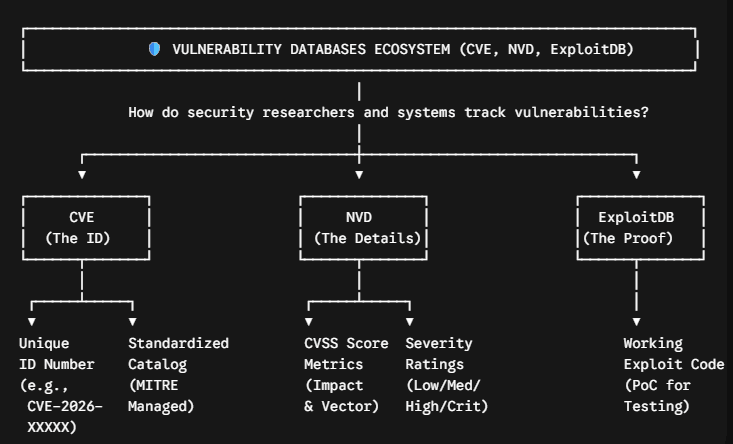
In the fast-paced world of cybersecurity, new software flaws and security weaknesses emerge almost daily. Without a centralized way to track and understand these issues, security teams would operate in silos, wasting valuable time researching the same vulnerabilities repeatedly and struggling with inconsistent naming conventions.
Enter vulnerability databases—the standardized, centralized repositories that act as a single source of truth for the global cybersecurity community. In this post, we will break down what vulnerability databases are, their core building blocks, and the distinct roles played by platforms like CVE, NVD, and ExploitDB.
Before vulnerability databases became the industry standard, security teams worked in isolation. A critical bug discovered by one organization might be named entirely differently by another, making patch tracking and risk management chaotic.
Modern vulnerability databases solve this by providing:
To make vulnerability data actionable, databases rely on a set of universal building blocks:
CVE (Common Vulnerabilities and Exposures): A public catalogue managed by MITRE that assigns a unique identifier (e.g., CVE-2021-44228 for Log4Shell) to ensure consistent referencing across tools and reports.
CVSS (Common Vulnerability Scoring System): A numerical scoring system that reflects how easily a vulnerability can be exploited and its potential impact (e.g., a 9.8 score is critical).
CPE (Common Platform Enumeration): A standardized naming format for vendors, products, and versions to precisely define what software is vulnerable.
CWE (Common Weakness Enumeration): Classifies the underlying root cause of a security flaw (e.g., CWE-89 for SQL Injection or CWE-94 for code injection), explaining why the flaw exists.
CNA (CVE Numbering Authorities): Authorized organizations (like Microsoft or GitHub) that assign CVE IDs to newly discovered vulnerabilities in their own products, helping scale the program.
Not all vulnerability databases serve the same purpose. Different platforms complement each other by focusing on different stages of vulnerability management:
Maintained by MITRE, the CVE List focuses purely on identification and tracking. It provides a standardized name, a brief description, and affected product info. However, it does not analyze severity or provide remediation guidance.
Maintained by NIST, the NVD builds directly upon the CVE List by enriching records with deep analysis, structured data, CPE mappings, and detailed CVSS metric breakdowns. Security tools heavily rely on the NVD for vulnerability prioritization and risk-based decision-making.
While CVE and NVD focus on identification and assessment, exploit-focused databases like ExploitDB concentrate on real-world attack techniques and proof-of-concept (PoC) code. Penetration testers and red teamers use ExploitDB (identifying entries via EDB-IDs like EDB-52468 for CVE-2025-10327) to understand how vulnerabilities are practically abused in the wild.
A crucial takeaway for any security professional is the difference between Severity and Risk:
Vulnerability databases form the backbone of modern vulnerability management. By understanding how to navigate resources like the CVE List, NVD, and ExploitDB, security analysts, administrators, and pentesters can prioritize threats efficiently, assess risk accurately, and secure their environments before attackers strike.
What are your go-to tools or databases when researching a new vulnerability? Let me know in the comments below!