
Logo
Warrior's Blog
Technology•Oct 7, 2026•4 min read•
Ceff
Ceff

Demystifying Cross-Site Scripting (XSS): From Injection Mechanics to Advanced Filter Evasion

Demystifying Cross-Site Scripting (XSS): From Injection Mechanics to Advanced Filter Evasion

Demystifying Cross-Site Scripting (XSS): From Injection Mechanics to Advanced Filter Evasion

Cross-Site Scripting (XSS) remains one of the most pervasive vulnerabilities in modern web applications. Despite being listed consistently in the OWASP Top 10, developers frequently misconfigure output encoding, leading to severe security flaws. In this technical deep-dive, we will explore the core mechanics of XSS vectors, examine real-world exploitation patterns, and discuss modern filter evasion techniques.

1. The Core XSS Vectors

Understanding how untrusted data flows through an application is critical for both exploitation and remediation. XSS can be broadly categorized into four primary vectors:

  • Reflected XSS: Occurs when an application takes user input from an HTTP request (such as a query parameter ?q=) and immediately echoes it back in the response without proper sanitization or escaping. The malicious payload executes within the victim's browser context under the application's origin.
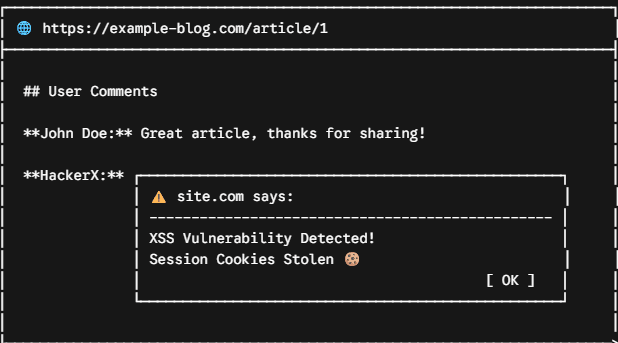
  • Stored XSS (Persistent): Considered more critical than reflected XSS, this happens when attacker-controlled input is permanently saved on the server (e.g., in a database via a comment section, user profile, or forum post) and later served to other users and administrators. Every visitor to the page automatically executes the payload.
  • DOM-based XSS: Entirely client-side. The vulnerability exists when client-side JavaScript reads data from an untrusted source (e.g., location.hash, location.search, or document.referrer) and passes it directly into a dangerous sink like innerHTML or eval(). Server-side protections are completely ineffective here.
  • Blind XSS: A specialized form of Stored XSS where the payload is executed in an environment the attacker cannot directly see—such as an internal admin support portal or ticketing system. Attackers rely on out-of-band (OOB) callbacks (like HTTP requests via fetch) to exfiltrate session cookies and metadata.

2. Contextual Payload Engineering

An XSS payload is rarely a one-size-fits-all string. Successful exploitation requires adapting the payload to the specific HTML context where the input is reflected:

A. Tag Breaking (input and textarea Contexts)

When user input lands inside an attribute or a raw text element, raw script tags might fail to execute directly.

  • Input Value Breakout: If input is rendered inside <input type="text" value="USER_INPUT">, the payload must break out of the attribute:HTML

"><script>alert('THM');</script>

  • Textarea Breakout: If rendered inside <textarea>USER_INPUT</textarea>, standard tags are treated as literal text until the element is closed:HTML

</textarea><script>alert('THM');</script>

B. JavaScript Context Escaping

When input is embedded directly inside a <script> block, attackers must terminate the existing statement cleanly before injecting arbitrary code:

JavaScript

// Reflected inside: var username = "USER_INPUT";
';alert('THM');//

The single quote closes the string, the semicolon terminates the statement, and // comments out the remainder of the original developer's code.

3. Navigating Filters and WAFs

Modern applications often implement basic filters or string replacement functions to strip malicious keywords (like script). Penetration testers leverage creative bypasses to circumvent these controls:

  • Keyword Stripping Bypass: If a filter removes the word script once, recursive or nested keywords can bypass the regex:HTML

<sscriptcript>alert('THM');</sscriptcript>

  • Event Handlers and Attribute Injection: When angle brackets (< and >) are blocked or filtered out within existing tags (such as <img>), attackers can rely on event handlers like onload, onerror, or onmouseover:HTML

/images/cat.jpg" onload="alert('THM');

4. Remediation and Defense-in-Depth

Securing applications against XSS requires a defense-in-depth strategy:

Context-Aware Output Encoding: Always escape untrusted user input before rendering it in HTML, attributes, or JavaScript contexts. Use built-in framework protections correctly (avoiding dangerous bypass filters like |safe in Jinja2 unless absolutely necessary).

Content Security Policy (CSP): Implement a robust CSP header to restrict where scripts can be loaded from and disable inline script execution (unsafe-inline).

Secure Cookies: Set the HttpOnly flag on sensitive session cookies to prevent them from being accessed via document.cookie even if an XSS vulnerability exists.